Pinning Down the Sonoran Desert on a Map Is Harder Than It Looks, Says ASU Mapping Expert
Matthew Toro of Arizona State University Library explains why the boundaries of the Sonoran Desert vary from map to map and why knowing them still matters for conservation.
By Juan Gonzalez ·
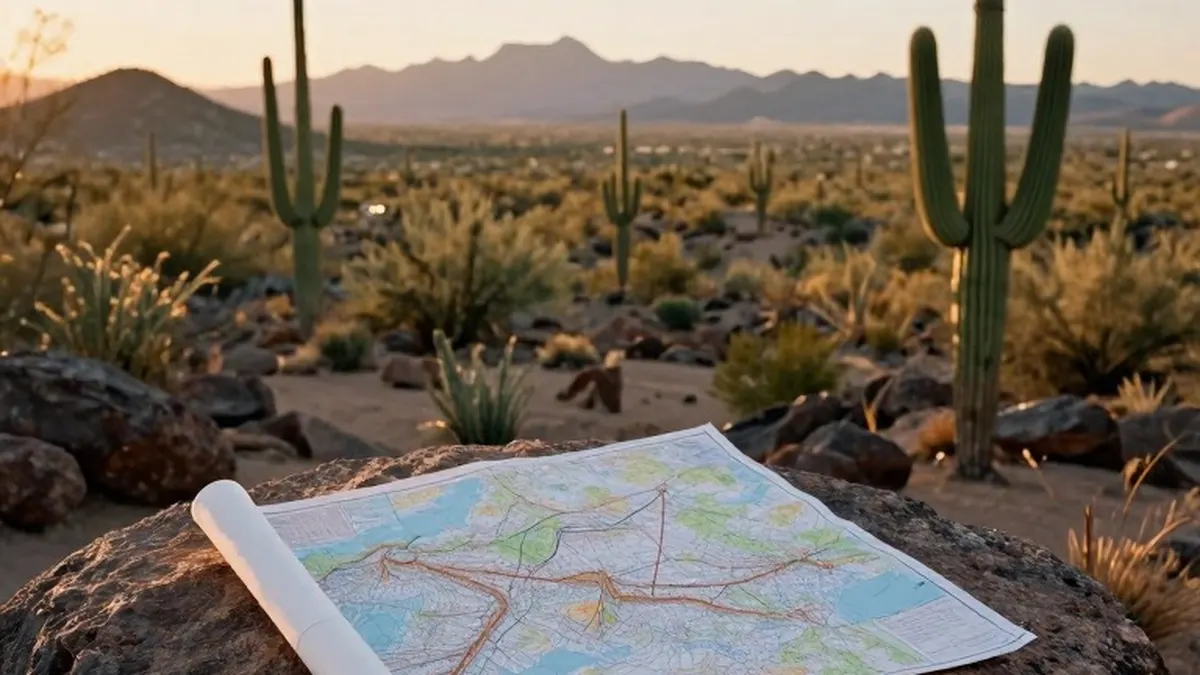
Where exactly does the Sonoran Desert begin and end? The question sounds simple, but it has no tidy answer, according to a mapping specialist at Arizona State University. The question opens Saguaro Land, a series from KJZZ's The Show that explores the desert season by season through music, art, literature, food, drink, flora and fauna, and maps.
Matthew Toro, director of maps, imagery and geospatial services at the ASU Library, told host Mark Brodie that geographic classification is never black and white. Sorting ecological regions by plant communities or by physiographic features such as mountain ranges, he said, leaves gray areas, and there is no clean and simple answer.
Toro said different maps do show different boundaries for the desert. He pointed to the nature of map making and the scientific data behind it, along with the discretion of the cartographer, who makes what amount to graphic design decisions. Differences also come from where the data originated and how recent it is. As researchers from various scientific disciplines compile new information, the accepted classification of regions changes.
Mapping human constructs such as county lines or census tracts is far easier, Toro said. Nature rarely offers clean geometric lines. "Nature is inherently fuzzy," he said, noting that plant communities are not always clearly distributed and that mountain ranges, though they seem fixed on a human timescale, do change.
To settle on a boundary, Toro said, scientists rely on established precedents that combine information from several fields. These include the physical layout and elevation of the land, plant communities and the distribution of flora and fauna. The saguaro is widely associated with the Sonoran Desert, but the overlap is imperfect. Some saguaros grow outside areas firmly classified as Sonoran, and parts of the Sonoran Desert have none. He offered a comparison: the Joshua tree is often linked to the Mojave Desert, yet some sections of the Mojave have no Joshua trees at all.
Toro described the work as an unenviable task for ecologists, biologists and biogeographers, and said it is ongoing. People tend to assume everything has already been mapped, he said, but methods of mapping and data collection keep growing more sophisticated. Satellite imagery and other sources still need "boots on the ground" to verify them.
He also stressed the relationship between field scientists and the cartographers who turn their data into maps. Trust and transparent data pipelines matter, he said, because information gathered from GPS receivers, ground observations and photographs is eventually assembled by one cartographer or a small group into seemingly authoritative documents. What happens behind the scenes, Toro said, is often messier than people believe. "Humans love to simplify reality and compartmentalize the world," he said.
Brodie asked whether it matters to know exactly where the desert lies, given that Phoenix is clearly within it. Toro answered yes, mainly because of a human responsibility to conserve and protect these regions. Policy, he said, can only develop from baseline scientific facts. Whether a particular settlement sits in one part of the Sonoran Desert or another is probably not important, but protecting its plants, animals and ecological diversity is.
Toro closed by calling for what he termed geographical consciousness: claiming one's city, community and ecology, and helping protect it. People often see themselves as separate from their ecosystem, he said, but humans are a dominant and sometimes violent ecological actor. Greater awareness of the surrounding region, he said, would help residents become better stewards of it.
Originally published by News Media House · Source: KJZZ