Fiona Leaves Over Half a Million Without Power Across Atlantic Canada
Post-tropical cyclone Fiona struck Nova Scotia with record-setting winds, cutting electricity to more than 500,000 people, and one woman is missing in Newfoundland.
By Amy Swan ·
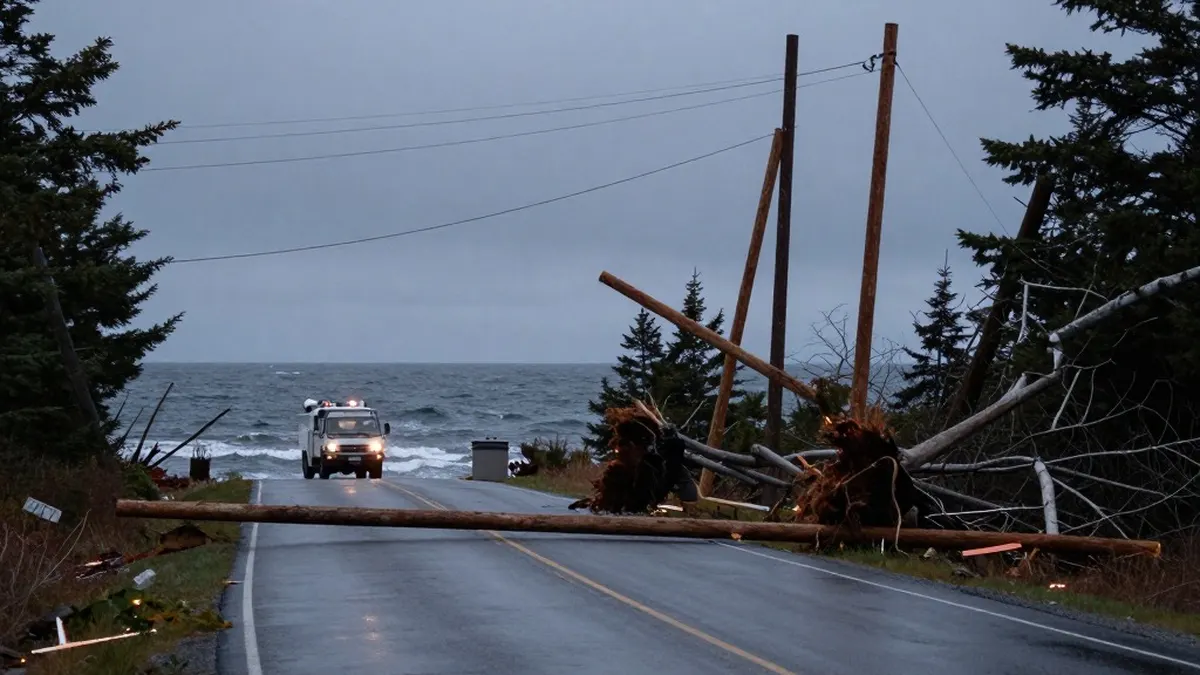
More than half a million people along Canada's Atlantic coast remained without electricity on Saturday after Fiona came ashore in the early hours of the morning with record-breaking wind speeds, according to reporting from NPR's Emma Jacobs in Montreal.
Fiona reached Nova Scotia as a post-tropical cyclone, yet it still delivered heavy wind and rain across a vast area covering five provinces. Among the hardest-hit places appears to be Port aux Basques, a small town in Newfoundland, where a number of houses were swept out to sea. A woman there is reported missing. Officials say no deaths have been confirmed so far.
At an emergency update briefing held in the afternoon, Nova Scotia Premier Tim Houston described what he had seen near his own rural home. "Roads washed out, including my own, an incredible amount of trees down and not just power lines across the roads - in many cases, entire power poles downed, snapped in half," he said.
Restoring electricity is expected to take days. Earlier in the day, four in five customers in Nova Scotia had lost power, as had nearly all households on Prince Edward Island. Those figures began falling slowly as the day went on, but the work is far from finished.
Peter Gregg, the head of utility Nova Scotia Power, said conditions in some areas were still too hazardous for technicians to go up in bucket trucks. He noted that significant wind persisted in parts of the province, with peak gusts of a kind not previously seen there. "Damage has been widespread and severe," he said, adding that healthy trees had been uprooted.
Local authorities and the Red Cross worked in the afternoon to open shelters. In some places, the shelters themselves had to be relocated because the original sites had lost power.
Hurricanes striking Canada's Atlantic coast are less commonly in the news than those hitting the Gulf of Mexico or the U.S. East Coast, but the region does periodically receive the remnants of such storms, including Dorian in 2019. Jacobs explained that unusually warm Atlantic waters allowed Fiona to push north with considerably more force, and that it set many records for wind speeds in the region.
Scientists are now carrying out analysis to determine how much climate change worsened this particular event. In general terms, Jacobs said, warmer water and air produce more powerful and wetter storms, which also tend to move more slowly after landfall. That matters because a strong storm can linger over an area for hours, battering it with rain and wind, causing more damage and making recovery harder.
Originally published by News Media House · Source: LAist
More News · Los Angeles news · Report a business · Got a Story?