Midterm voting surges as Alaska probe widens
Early ballots are up nearly 10 million compared to 2022, while federal officials test Alaskan ballots and Michigan Democrats trade public criticism.
By Mei Wojcik ·
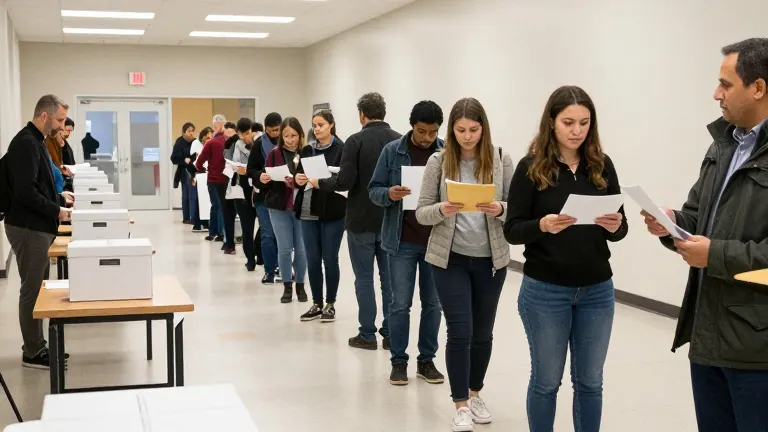
Millions of Americans have already cast their ballots for the upcoming midterm elections, with early voting numbers running nearly 10 million higher than at the same point in 2022. This surge is particularly visible in states with competitive Senate races, where turnout increases of roughly 30% are challenging both parties' expectations. The high volume of advance voting sets the stage for a contest that will determine whether President Donald Trump finishes his term with a Republican Congress or faces Democratic opposition.
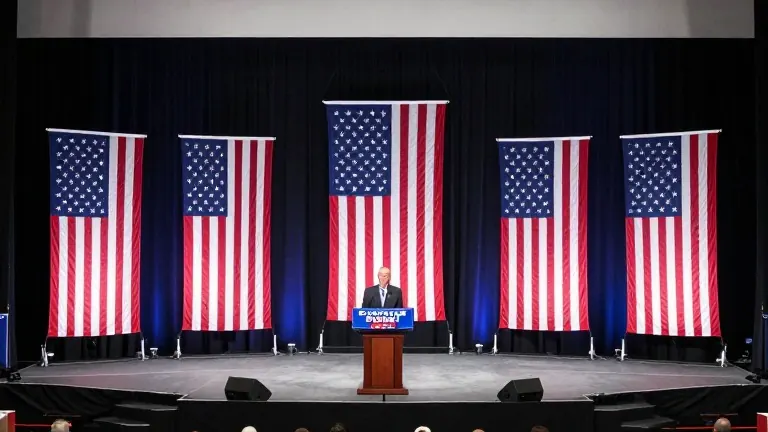
President Trump and former President Bill Clinton both addressed crowds this week, urging voters to participate. On Friday, Trump spoke to supporters in Daytona, Florida, calling these the most important midterm elections ever. Earlier that day, Clinton addressed Democrats in Tupelo, Mississippi, invoking the late George H. W. Bush to argue that democracy is self-correcting. Clinton specifically urged the crowd to vote for Democratic Senate candidate Scott Colom.
The political fight has intensified in Alaska, where U.S. Attorney Michael Heyman confirmed a criminal investigation into a potential voting scheme. Law enforcement has surged resources to the state to examine ballots ranking a candidate named Dan J. Sullivan, who shares a name with the Republican incumbent, Sen. Dan Sullivan. The probe follows reports that Democratic candidate Mary Peltola may have been involved in recruiting the lookalike candidate. Peltola denied knowledge of the effort, but the Justice Department aims to measure the level of voter confusion by isolating and testing specific ballots.
Campaign logistics have shifted rapidly in the final weeks. Trump initially suggested he might rely more on telerallies, canceling weekend trips to Iowa and Kansas. By Friday, he reversed course and scheduled back-to-back rallies for those states on Sunday. In Kansas and Iowa, the Senate races are pivotal for the Republican majority. Trump has already visited both states to support Sen. Roger Marshall and House member Ashley Hinson.
In Michigan, tensions between Democratic rivals have resurfaced just before the general election. Rep. Haley Stevens, who lost the primary to progressive Abdul El-Sayed in August, appeared on CNN to say she would vote for El-Sayed but urged him to repair ties with Jewish and Black voters. Stevens criticized El-Sayed in a lengthy social media post, demanding he condemn an advertisement linking U.S. support for Israel to rising grocery prices. El-Sayed responded by saying Stevens is relitigating the primary and that the focus should be on beating Republican candidate Mike Rogers. Rogers praised Stevens for speaking out and criticized El-Sayed's response.
Voting data shows distinct regional patterns in the surge. In Texas, more than 6.3 million voters cast early ballots as of Wednesday, a 50% increase over the same period four years ago. Early voting is up more than 30% in Maine, Michigan, North Carolina, and Kansas. In South Carolina, where voters are selecting a successor to the late Sen. Lindsey Graham, early turnout has increased by 83%. Both parties are watching these numbers closely, with Republicans worried about low turnout among their base and Democrats focusing on affordability issues.
Source: Pasadena Star-News