
Texas redistricting reshapes 2026 House race
A mid-decade map change in Texas triggered a national cascade of partisan redistricting battles ahead of the midterms.
By Mei Wojcik ·
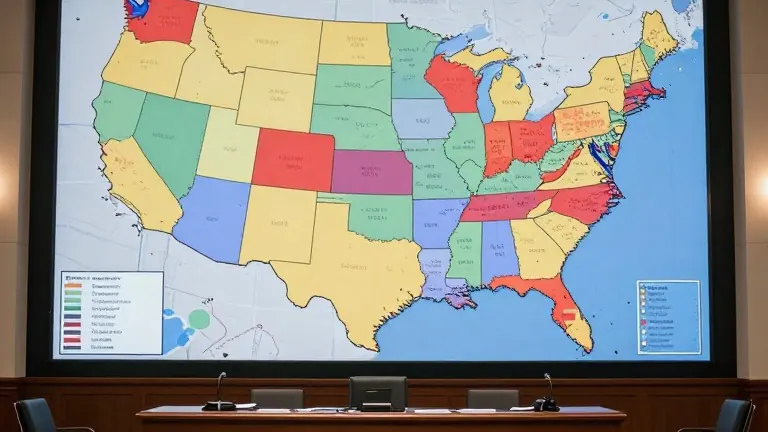
Texas lawmakers enacted a new congressional map that shifts five seats from Democratic to Republican control, altering the landscape for the 2026 midterm elections. The move follows a direct request from President Donald Trump in the summer of 2025 for the state to redraw its districts to gain up to five additional House seats for the GOP. This mid-decade adjustment is unusual, as states typically only update maps once every ten years following a census to reflect population changes. The primary goal was to protect the Republican majority in the U.S. House, which is essential for advancing the President's legislative agenda during a year that is historically difficult for the party in power.
Governor Greg Abbott ordered state legislators to return to Austin to finalize the plan. The Texas House subsequently unveiled a map designed to flip five previously blue districts to red. Democratic lawmakers initially attempted to block the vote by leaving the state. With only 150 members in the chamber, a quorum requires at least 100 present to conduct business. By exiting the state, Democrats broke this legal threshold and delayed proceedings. After a few weeks of this standoff, Democrats returned, and the new map passed into law.
The Texas action ignited a chain reaction across the country. Matthew Wilson, a political science professor at SMU, described the situation as a partisan tit-for-tat. "Texas acted, and then other states acted in response, like California," Wilson said. "And then it was a cascade of Democrat and Republican states going back and forth with each other." This dynamic turned a routine legislative task into a high-stakes national contest involving multiple state legislatures.
The practice of gerrymandering has roots dating back to 1812. Elbridge Gerry, then Governor of Massachusetts, signed a bill creating a bizarrely shaped state senate district. A Boston newspaper responded with a cartoon adding claws and wings to the shape, coining the term "gerrymander." Today, the process often involves two main tactics: cracking and packing. Cracking splits a group of voters across multiple districts to dilute their power. Packing concentrates a group into as few districts as possible, giving them overwhelming majorities in those areas while reducing their influence elsewhere.
Despite public skepticism, gerrymandering remains legal. In 2019, the U.S. Supreme Court ruled that while excessive gerrymandering may conflict with democratic principles, it is not unconstitutional. Federal courts lack the authority to determine if a map goes too far. Wilson noted that parties can disadvantage opponents significantly because political parties are not a protected class under the Constitution. However, mapmakers cannot intentionally disenfranchise voters based on race or ethnicity.
Public opinion suggests many Americans dislike the current state of map-drawing. A recent YouGov poll found that 71% of Americans believe states should not be allowed to draw congressional districts that intentionally favor one party. Yet, Wilson observed that many voters may not be fully engaged with the issue. "People who closely follow politics understood that the national stakes of these dueling redistricting battles were quite high," Wilson said. "I think most voters just going about living their lives, they vaguely heard this was going on, it wasn't a big priority to them one way or the other."
The current map configurations in Texas feature distinctive shapes. District 33 resembles a malformed butterfly, while District 9 looks like a whale character from popular animation. District 32 is oblong, similar to a tobacco pipe. These visual quirks are a byproduct of the effort to create districts that advantage specific political interests rather than geographic neatness. The legal framework allows for this focus on political advantage as long as racial groups are not the primary target of the disenfranchisement.
There is a potential downside to these aggressive redistricting efforts, often called a dummymander. If the maps are too lopsided, they may not yield the expected results. Wilson argued that voters generally prefer competitive elections. "They would like more districts that could legitimately go either way, and it would be healthier for democracy," he said. When a district is overwhelmingly Republican or Democratic, the decisive election often occurs in the primary months earlier in the year, reducing the impact of the general election in November.
Source: KTVT