Yemeni families struggle after recent losses
Rising fuel costs and irregular aid complicate life for bereaved households in Sanaa as fighting intensifies.
By Karan Grant ·
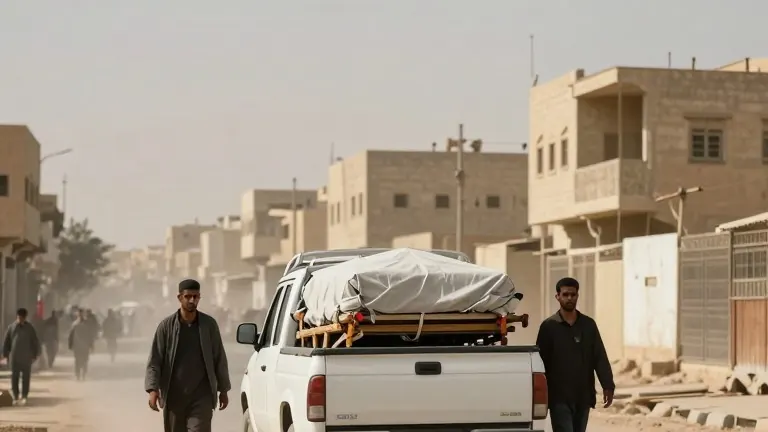
Pickup trucks carrying the bodies of Houthi fighters move through the streets of Sanaa, Yemen, accompanied by gunmen and loud speakers playing a song titled “Our martyrs are our greats.” These processions have become a frequent sight in the capital over the past few weeks, marking the deaths of soldiers in the ongoing conflict.
The Yemeni government announced earlier this month that its forces killed or wounded 1,540 Houthis in a single day. By last week, officials stated that 16,100 Houthi operatives and commanders had been killed or wounded since October 5. Pro-government troops have also suffered heavy losses, with more than 70 government soldiers killed in a missile attack on a security camp in Shabwa on October 19.
Akram, a 23-year-old resident of Sanaa, lost his 21-year-old brother Abdulaziz on October 10. Abdulaziz was killed in Dhubab, in southwestern Yemen, just two months after joining the Houthi group. Before his death, the two brothers worked as daily-wage laborers in construction and agriculture, pooling their earnings to support their family of six.
“I lost my pillar of strength, Abdulaziz,” Akram said. “His income, along with mine, used to cover water, electricity and food expenses. Without him, I am like a bird with one wing, burdened by so many responsibilities.” Akram noted that the family’s financial difficulties have become harder to manage since the loss.
Economic pressures have increased for families in Houthi-controlled northwestern Yemen as petrol and diesel prices rose by 10 percent in recent days. Akram explained that bills do not pause for grief. “When it comes to paying the fees for water, electricity, or buying groceries, it does not matter if your relative is a martyr or not. You have to pay or starve to death,” he said.
Houthi authorities provide food baskets containing flour, cooking oil, rice, and sugar to families of deceased fighters. However, the distribution of this aid is often irregular. Ali Yahia, a 55-year-old father in Sanaa whose son died on the Saudi-Yemen border four years ago, receives these baskets at varying intervals. He sometimes gets them twice a year, other times three or four times.
Yahia believes that fair compensation should amount to at least $200 per month to help families cover basic needs. His two surviving sons, who work as a delivery rider and in a restaurant, currently support him. He described the death of a breadwinner as a living and psychological ordeal for the entire family.
The World Food Programme reported that 18.3 million people across Yemen face severe food insecurity, while 2.2 million children under five suffer from acute malnutrition. Matthew Hollingworth, the WFP Assistant Executive Director for Programme Operations, stated earlier this month that the latest escalation threatens to be absolutely devastating for food security. “We are looking at a hunger crisis that is going to grow as it persists,” Hollingworth said.
Ali Mohammed, a Houthi representative in Sanaa, acknowledged that the rising number of martyrs affects the level of support families receive. He argued that complete Houthi victory would lead to stability, giving authorities a better opportunity to care for bereaved families, though he admitted this process would take time.
Adel Dashela, a researcher at the Sanaa Center for Strategic Studies, described the public celebration of fallen fighters as an alien practice that emerged during the war. He noted that this ritual normalizes violence and encourages children to risk their lives under various political slogans. Dashela observed that while women and children often assume responsibility for supporting families after the death of the breadwinner, public displays of honor do not alleviate their suffering.
The UN estimated at the end of 2021 that 377,000 people had been killed directly or indirectly by the war in Yemen. The recent return of fighting has added to this toll, leaving families in Sanaa to bear the financial and psychological burden of their losses.
Source: Al Jazeera