China Fiscal Policy: Local Debt Squeeze Slashes Urban Spending
IMF data shows augmented debt at 126.6% of GDP, forcing a 3.5% drop in fiscal outlays and halting infrastructure investment growth.
By Mei Wojcik ·
Global financial institutions are urging Beijing to increase expenditure, yet local authorities are cutting back due to a structural collapse in revenue.
The International Monetary Fund (IMF) estimates that China's general government debt stands at 68.4% of GDP. However, when including local government financing vehicles and off-balance-sheet borrowing, the augmented government debt reached 126.6% of GDP last year. This level of leverage is comparable to that of the United States and European economies. The discrepancy between the on-book and off-book figures creates a fiscal constraint that limits Beijing's ability to stimulate the economy through traditional channels.
Local governments have historically funded roads, rail lines, and industrial parks through land sales to developers. The property slump that began in 2021 severed this funding stream. CF40, a Beijing-based think tank, estimates that land-sale income has more than halved since 2021. Revenue dropped from 8.7 trillion yuan to 4.2 trillion yuan, a sum equivalent to approximately $590 billion. This sharp reduction in cash flow has directly impacted public spending. Ting Lu, chief China economist at Nomura, estimates that combined fiscal spending declined by 3.5% during the first eight months of 2026. This marks a reversal from the 3.6% growth recorded in the previous year, creating what Lu describes as a true fiscal cliff.
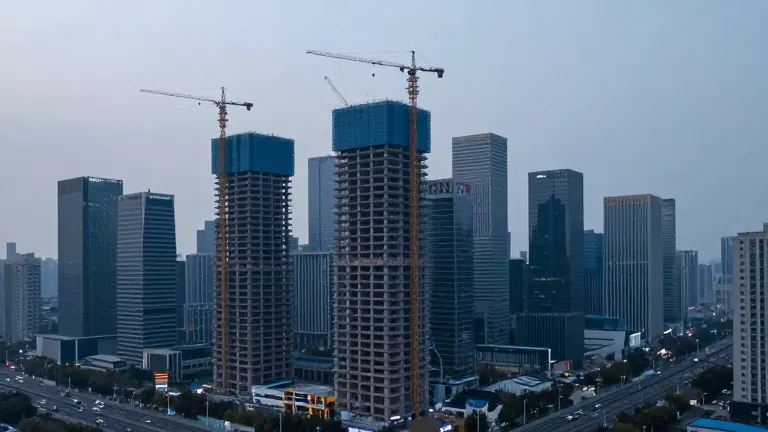
The reduction in spending has stalled physical infrastructure development. Urban fixed-asset investment fell for the first time in decades, dropping 3.8% last year. The decline accelerated in 2026, with investment down 7.2% in the first three quarters. Beijing maintained its official deficit target at approximately 4% of GDP. The Institute of International Finance calculates that the actual deficit may reach 9% of GDP, a figure it deems insufficient for current economic needs. The IMF projects China's economic growth will slow to 4.5% this year from 5% last year, with a further deceleration to 4% in 2027.
Beijing has mandated that state-backed borrowers clear hidden debt and transition into market-oriented commercial state-owned enterprises by mid-2027. S&P Global Ratings reports that hidden debt in these vehicles decreased to 6.5 trillion yuan, or $973.3 billion, last year, down from 14.3 trillion yuan in 2023. Despite this reduction, S&P notes that many of these entities lack sufficient cash flow to cover interest payments and remain burdened with unprofitable public projects. Krishna Srinivasan, director of the IMF's Asia and Pacific department, advised Beijing to adopt a medium-term fiscal framework. This approach would allow for near-term fiscal expansion to reflate the economy while clawing back support over time to ensure debt sustainability.
The political stakes of managing this debt load remain high. Logan Wright, a partner at Rhodium Group, noted that no local government official wants to be the first to default. However, Wright argued that once one municipality defaults and receives a bailout from Beijing, other officials may expect similar treatment. This dynamic can cause local priorities to diverge from central directives, with some officials potentially preferring to default to shed liabilities. The IMF also recommends that China move away from point growth targets, which it argues push local officials to overinvest and misallocate resources, thereby increasing provincial debt.
IMF Managing Director Kristalina Georgieva described the United States and European nations as the worst offenders regarding debt during meetings in Bangkok earlier this month. She summarized the global prescription by stating that China needs to spend more, the United States must save more, and Europe must invest more. The fund continues to press Beijing for more meaningful fiscal stimulus as the economy faces deflationary pressures.
Additional corporate and political developments in China include a statement from Volvo Cars CEO Håkan Samuelsson, who attributed a weaker third quarter to tougher market conditions in China and the United States. He noted that Chinese consumers are increasingly selecting domestic brands. The company plans to revamp its business around regionally adapted cars. Separately, the House Select Committee on the Chinese Communist Party reported that internal messages from Webull indicate employees in China could access sensitive U.S. user data. The panel stated this raises national security risks. Wealthy Chinese investors are also seeking U.S. bank accounts and offshore asset structures following Beijing's imposition of retroactive levies on offshore trusts in July.
China's Communist Party will hold its fifth plenary meeting from October 26 to 29. The country's industrial profits year-to-date are scheduled for release on October 27. Official manufacturing PMI data for October is expected on October 31, with the RatingDog manufacturing PMI following on November 2.
Source: CNBC
More Business · Unethical Practices · Report a business · Got a Story?