Lebanon: Ceasefire breach kills veteran reporter as journalist survives drone strike
Zeinab Faraj and Amal Khalil were documenting war damage in southern Lebanon when a missile and subsequent drone attacks left one dead and the other trapped under rubble.
By Mei Wojcik ·
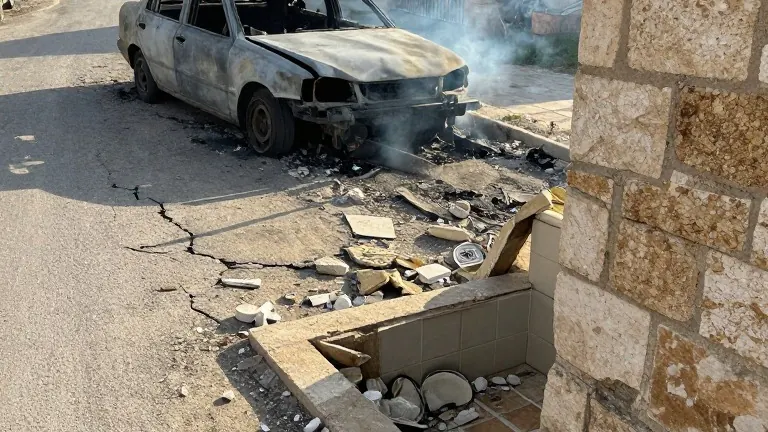
One hour separates the moment paramedics rescued a young photojournalist from the moment a veteran reporter died nearby in southern Lebanon. The timeline of events on April 22, 2026, reveals a chaotic sequence of strikes that occurred just days after a ceasefire agreement was signed between Israel and Lebanon.
Zeinab Faraj, 21, and Amal Khalil, 42, traveled to the village of al-Tiri to document the aftermath of a month of airstrikes. They were accompanied by two men in a separate vehicle ahead of them. The group had met earlier that day at Tebnine governmental hospital, a location locals considered a relative safe zone. Despite a scheduled marriage contract signing that evening, Ali Nabil Bazzi, a 27-year-old municipal official, joined the trip.
Faraj reported hearing no warning before the first missile struck the car ahead. The vehicle caught fire immediately. When the women exited their own car to investigate, they found the bodies of Bazzi and his companion, Mohammed Hourani, 37. Khalil, a newspaper reporter, began calling emergency services while Faraj attempted to locate Bazzi. During this time, drones descended to a low altitude, hovering close to the journalists' faces.
Emergency services on the phone assured the pair that ambulances were en route. Faraj described these assurances as an anesthetic that numbed the reality of their situation. When the women attempted to re-enter their car to leave, a second missile struck the vehicle. The impact threw both women backward. Khalil wrapped her arms around Faraj as the drone circled overhead. Khalil reportedly hoped the drone would assume they were dead.
The two took shelter in a nearby house. Khalil sustained visible injuries to her face, hand, and leg. Faraj sent a final message to her sister before her phone battery died: “There’s no hope left. Forgive me.” Inside, Faraj crawled to a vantage point to watch the road. A drone suddenly descended toward her, causing her to feel a sudden detachment from the event. Shortly after, another missile fell, creating a sound Faraj described as unlike anything she had previously experienced.
Faraj lost consciousness and woke up trapped under rubble. A paramedic reached her after clearing debris. She clung to him, stating she was afraid to stay alone. As the drone returned, the paramedics pulled her free. She heard a stun grenade dropped by the drone during the extraction. In the ambulance, she repeatedly mistook the sound of the vehicle for an incoming drone, fearing they would not make it to the hospital.
Upon arrival, Faraj asked about Khalil. Nurses initially offered reassurances before falling silent, signaling Khalil’s death. Khalil is believed to have died approximately one hour before paramedics were permitted to return to the scene. The Israeli military stated the attack targeted saboteurs violating the ceasefire. Human rights groups labeled the incident a war crime. Israeli forces had received messages urging them to allow a rescue operation while the journalists were trapped.
A week prior to the attack, an Israeli military spokesperson shared a video of Khalil on social media, describing her work as “terrorist media.” Khalil had also received death threats from Israeli phone numbers. The incident has left lasting physical and psychological marks on Faraj. She is preparing to return to university but struggles to walk without a limp. Visible injuries remain on her hand and face, affecting the movement of one eyebrow. Other injuries are hidden by her clothing and hijab.
Faraj now wakes at night screaming and buries herself in pillows to shield against perceived missiles. The sound of drones and warplanes triggers intense anxiety. Returning to frontline journalism remains uncertain for her. She is frequently haunted by the image of Hourani on the ground after the first strike. She recalls his head turned toward her with open eyes, a vision she says she will never forget.
Source: The Guardian